Last Updated on October 12, 2026 by Samantha Marceau
If you’ve ever followed a recipe exactly, felt really confident about it, and wound up with a less-than-stellar result, you’re in the right place. Let me reassure you: you’re not the problem; the ice cream base ratio is.
Most home ice cream recipes are written to taste good on a spoon, not to teach you anything. So when something goes sideways, you have no idea what to adjust. More cream? Less sugar? Different-sized egg yolks? Any change you make is a shot in the dark.
Understanding the components of an ice cream base ratio changes that. Once you know what the numbers actually do, you can look at any recipe—including your own—and immediately see where the problem is. And more importantly, you can start building flavors from scratch with real confidence instead of hoping for the best.
New to making ice cream? My Start Here guide walks you through it step by step.
What is an Ice Cream Base Ratio, and Why Does it Matter?
Ice cream is a careful balance of six things: ice crystals, fat, milk proteins, sugar, air, and water. Every ingredient you add shifts that balance—sometimes in your favor, sometimes not.
The ice cream base ratio is simply a way of tracking the four most important of those: fat, sugar, milk solids, and water, each expressed as a percentage of the total base weight. Professional makers track these numbers (among many others) obsessively. Home cooks almost never do, which is why home ice cream so often disappoints.
But you don’t need a spreadsheet or even a calculator to use these ratios effectively. You just need to understand what each number is doing and what it looks like when your ice cream base ratio is off.
The 4 Numbers That Make Up the Ice Cream Base Ratio
1. Fat (Target: 10–18%)
Fat is doing more than just making your ice cream rich. It physically coats ice crystals as they form during churning, keeping them smaller and smoother. It also traps the air bubbles that give ice cream its texture—too little fat and those bubbles collapse; too much and you end up whipping butter.
Ice cream approaching 20% becomes harder to scoop, slower to melt in the mouth, and can leave a slightly greasy finish. The sweet spot for most home recipes is 10–18%, with custard-style bases leaning toward the higher end thanks to the added fat from egg yolks. If you’d rather skip the eggs, see my no-egg Philadelphia-style base for how the numbers shift.
2. Sugar (Target: 13–22%)
Sugar’s primary structural job in ice cream is actually freezing point depression, not sweetness. When you dissolve sugar in water, you lower the temperature at which that water freezes. Lower freezing point means smaller ice crystals forming more slowly, which means a smoother, creamier, more scoopable result.
The type of sugar matters, not just the amount. Dextrose (glucose) is about ¾ as sweet as regular table sugar but lowers the freezing point almost twice as much, which is why you’ll sometimes see it in serious recipes. Even a small amount of corn syrup or honey works similarly, keeping ice cream softer at freezer temperatures without making it overly sweet. I use honey in my vanilla bean honey ice cream recipe to do just that (and add a subtle floral flavor).
3. Milk Solids Non-Fat, or MSNF (Target: 5–12%)
This is the ingredient most home cooks have never thought about, and one of the biggest reasons homemade ice cream falls short.
MSNF refers to the proteins, lactose, and minerals in your dairy, minus the fat. They’re already present in your milk and cream, but usually not in high enough quantities to make a meaningful difference. Adding skim milk powder is the most reliable way to boost MSNF at home.
Why does it matter? The proteins in MSNF help stabilize the emulsion, improve mouthfeel, and control the size of ice crystals during freezing. Too little (below 5%) and the ice cream tastes thin and icy. Too much (above 12%) and you get a chalky texture. Hit that 5–12% window and the difference is immediately noticeable.
4. Water (Target: 50–65%)
You’re probably thinking, “Why would I ever add water to ice cream?” But we’re never really adding water. There’s water in everything, from the milk (about 87% water) and cream (about 60% water) to the egg yolks and flavorings.
Water is what freezes. The fat, sugar, and proteins in your base are all, in a sense, managing the water, keeping it from freezing into large, coarse crystals. Stabilizers do a similar job by binding free water. I break down which one to use in Ice Cream Stabilizers 101.
Understanding water as an ingredient reframes how you think about mix-ins entirely. Fresh fruit? Mostly water. Alcohol? Aggressively lowers the freezing point of water (more on that below). Chocolate ganache? Adds water and fat simultaneously. Every decision you make about flavor is also a decision about water management.
Why Most Homemade Ice Cream is Too Rich
The most common at-home recipes default to a 2:1 cream-to-milk ratio, which lands you at around 17–18% fat. That sounds like a premium result, but it isn’t. At that fat level, the ice cream is harder to scoop straight from the freezer, slower to release flavor (fat coats your taste buds, delaying the hit), and can leave a heavy, slightly buttery finish.
The same counterintuitive logic applies to sugar. More sucrose means a lower freezing point and a softer scoop, which sounds ideal until the ice cream becomes too sweet before it becomes soft enough. That’s why experienced makers often swap a portion of sucrose for dextrose or a small amount of corn syrup: you get the textural benefit without the sweetness overload.
My Go-To Ice Cream Base Ratio (1 Quart, Custard-Style)
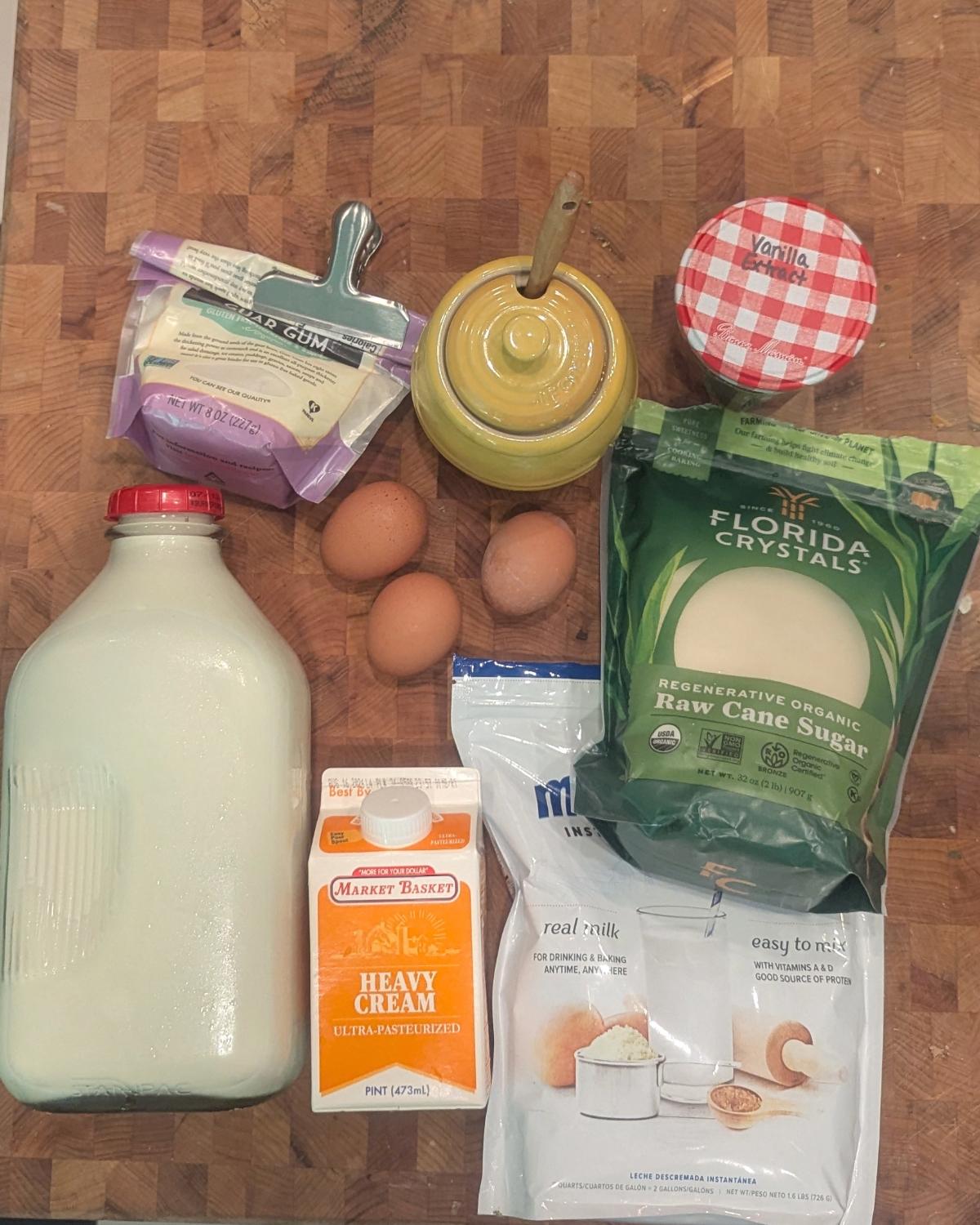
After trying a lot of different ratios, I landed on a custard base I love. It’s not too sweet, not too fatty, and not too eggy, either. Here’s the recipe I come back to again and again:
| Ingredient | Amount | What It’s Doing |
|---|---|---|
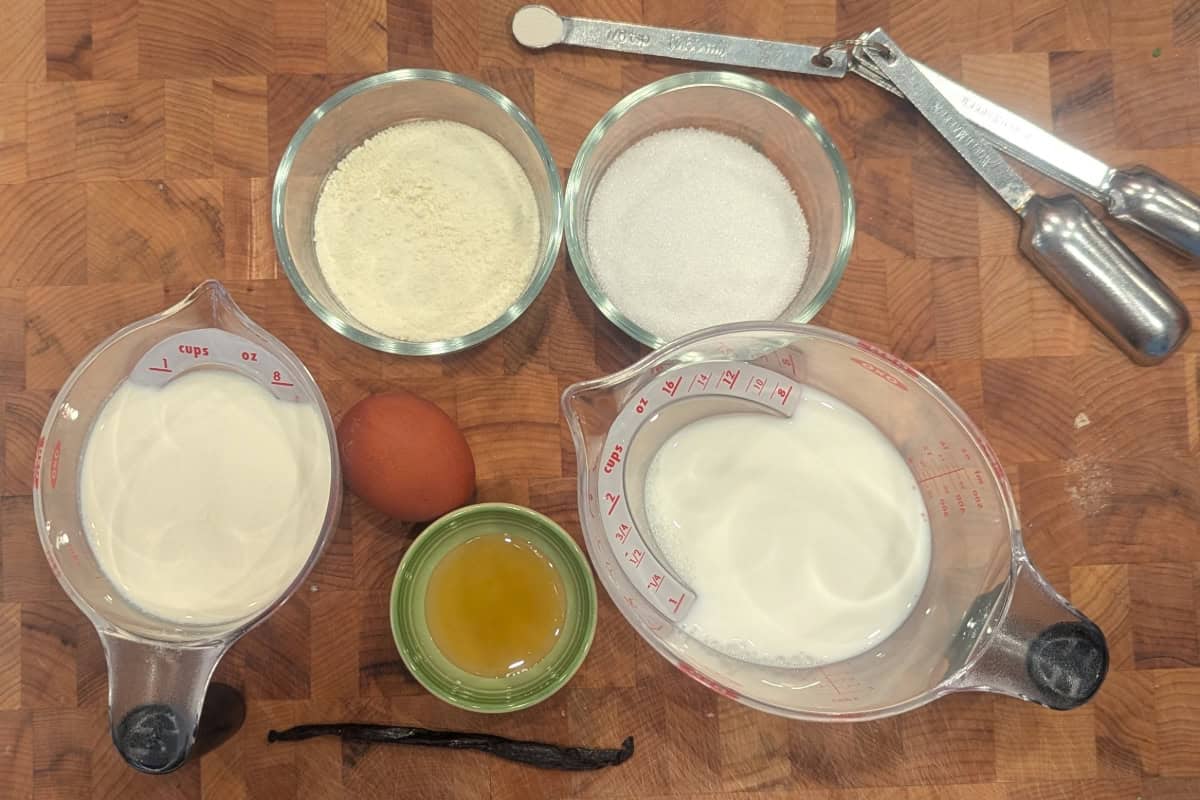
Heavy Cream | 1½ cups | Primary fat source — targets ~16% fat |
Whole Milk | 1½ cups | Balances richness — adds MSNF and water |
Granulated Sugar | ¾ cup | Sweetness + freezing point depression |
Skim Milk Powder | ½ cup | Boosts MSNF to ~11% — improves texture |
Egg Yolks | 3 | Emulsification, richness, stability |
Salt | Pinch | Flavor |
My favorite ratio of ingredients is simple. Here’s a reliable starting point for 1 quart of custard-style ice cream:
- Fat: ~16% — at the top of the range, which is a deliberate choice
- Sugar: ~17.7% — right in the middle, with room to adjust for sweeter flavors
- MSNF: ~11.2% — solid, with skim milk powder doing meaningful work
- Water: ~57% — well within range, leaving buffer for mix-ins
A note on fat: yes, 16% is near the ceiling. I keep it there intentionally, because it gives me room to add watery mix-ins (fresh fruit especially) without the base going out of balance. If you’re making plain vanilla or a low-water flavor, you can pull back to 1¼ cups cream and 1¾ cups milk for a slightly lighter, more immediately flavorful result.
How Common Mix-Ins Affect Your Ice Cream Base Ratio
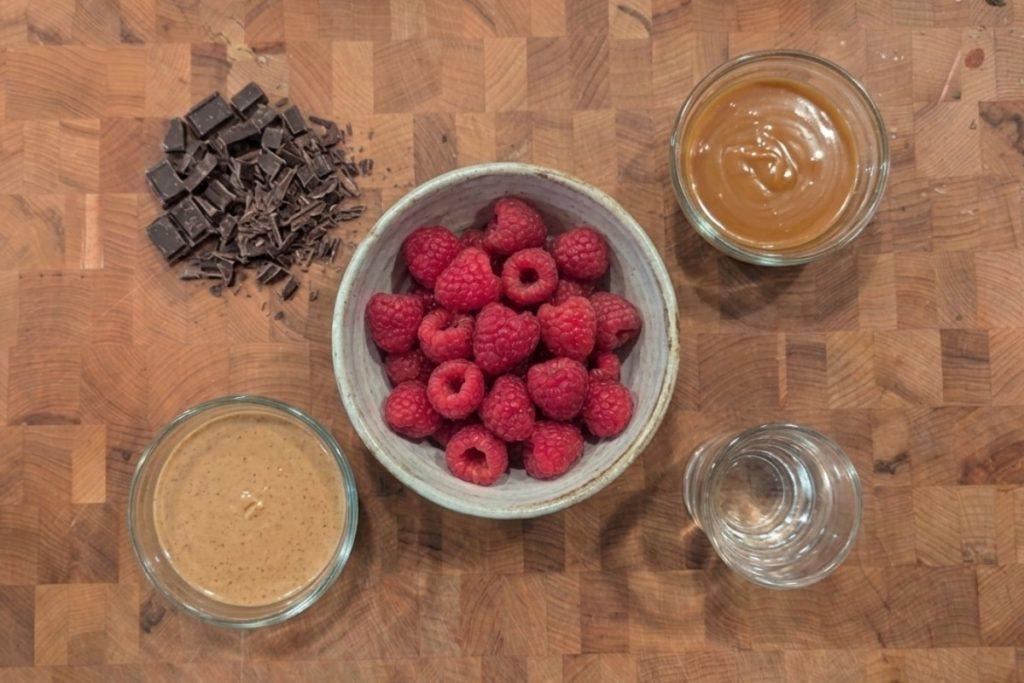
Now that you have your ice cream base in order, you have to consider how to balance it when mix-ins enter the mix. Mix-ins don’t only add flavor; they also contain fat, water, sugar, and solids. Here’s how the most common ones shift your ratios, and what to do about it:
Fresh Fruit
Fresh fruit adds significant water and natural sugar. The water is the bigger problem because it dilutes your fat and MSNF percentages while increasing the amount of free water available to form ice crystals.
Fix it by reducing the milk by the approximate weight of your fruit, or by cooking the fruit down first to concentrate it.
Related recipes: blood orange ice cream and lemon poppy seed ice cream.
Chocolate
Chocolate is one of the trickiest mix-ins because it adds fat and solids simultaneously. A full cocoa or melted chocolate addition can push your fat percentage well past 16% while also making the base denser.
Fix it by scaling back the cream and considering removing one egg yolk. For chocolate that stays soft in the freezer, try my soft fudge chunks.
Alcohol
Alcohol aggressively suppresses the freezing point more so than any sugar. A little (1–2 tablespoons) keeps ice cream scoopable; too much and it simply won’t freeze.
Fix it by keeping alcohol additions small, or compensate by increasing your MSNF with an extra tablespoon of milk powder.
Related recipe: Vermonty Python ice cream.
Nut Butters
Nut butters are high in fat (peanut butter is roughly 50% fat). Adding even ¼ cup can meaningfully raise your fat percentage.
Fix it by reducing heavy cream by about ¼ cup for every ¼ cup of nut butter you add.
Related recipe: pistachio ice cream with rhubarb jam swirl.
Caramel and Sugar Syrups
Caramel and sugar syrups add both sugar and water.
If you’re swirling in a caramel sauce, account for the extra sugar (and adjust sweetness in the base accordingly), or the finished ice cream may be too soft. My apple cider caramel sauce is designed to stay soft when frozen.
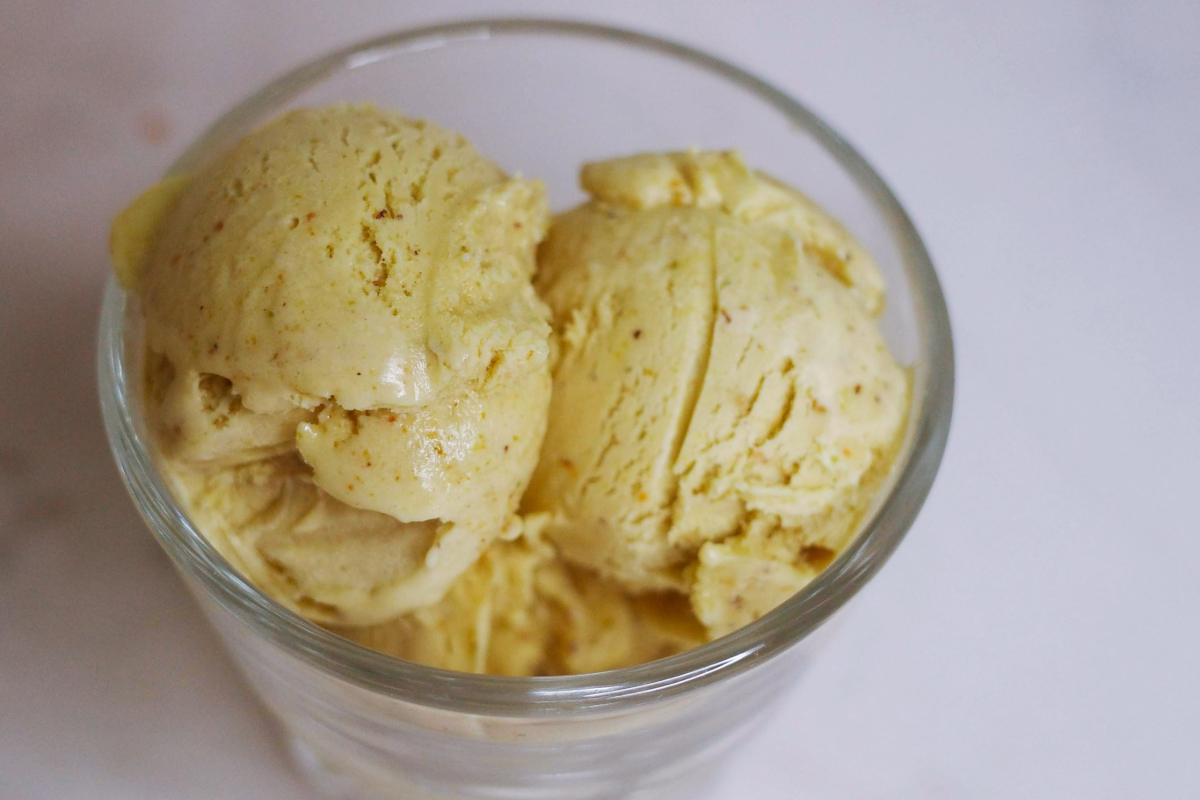
What Good Ice Cream Balance Actually Feels Like
Here’s what you’re aiming for when all four numbers are in range: the ice cream scoops cleanly after 5–10 minutes on the counter, holds its shape without weeping, melts slowly and evenly, and releases flavor immediately.
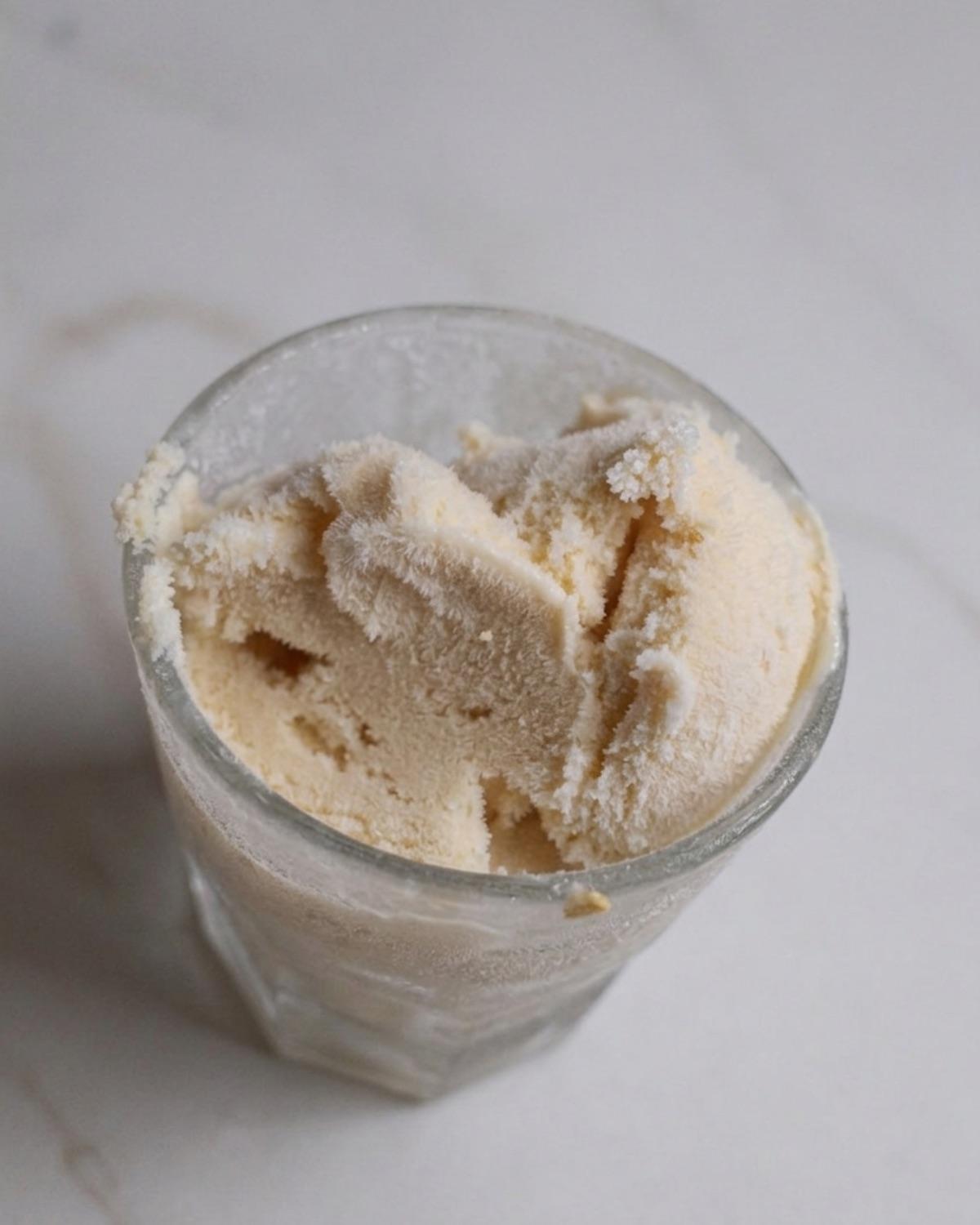
When fat is too high, the scoop is hard, and the flavor lags. If sugar is too low, the scoop is rock-hard. When MSNF is too low, the texture is icy and thin. If water is too high, you get large crystals and a grainy mouthfeel.
Once you know what you’re looking for, you can taste a problem and trace it back to its source.
You Don’t Have to Calculate This Ratio Every Time
The ice cream base ratio is a map, not a cage. Once you’ve internalized what each component does and how mix-ins shift things, you won’t be doing math every time you make ice cream. Instead, you’ll just be making decisions that feel intuitive because they’re grounded in understanding.
Start with the base above. Make it once as written. Then try it with strawberries, or chocolate, or bourbon caramel, and see what adjustments actually feel necessary versus what you can get away with leaving alone. That’s how the ratio goes from a mathematical formula to basic instinct.
Once your base is balanced, how long you churn it matters too, and every recipe here is designed for compressor machines. For more, browse Ice Cream Science.