Last Updated on October 16, 2026 by Samantha Marceau
If you’re beyond the basics and starting to get into developing your own homemade ice cream recipes, or just looking for ways to improve what you’re already making, you’ve probably heard the term “stabilizers” tossed around a time or two. And you’re probably wondering two things: do you actually need them, and if so, which one is the best? I’m here to answer your pressing ice cream stabilizer questions and help you decide if you need them or can go without.
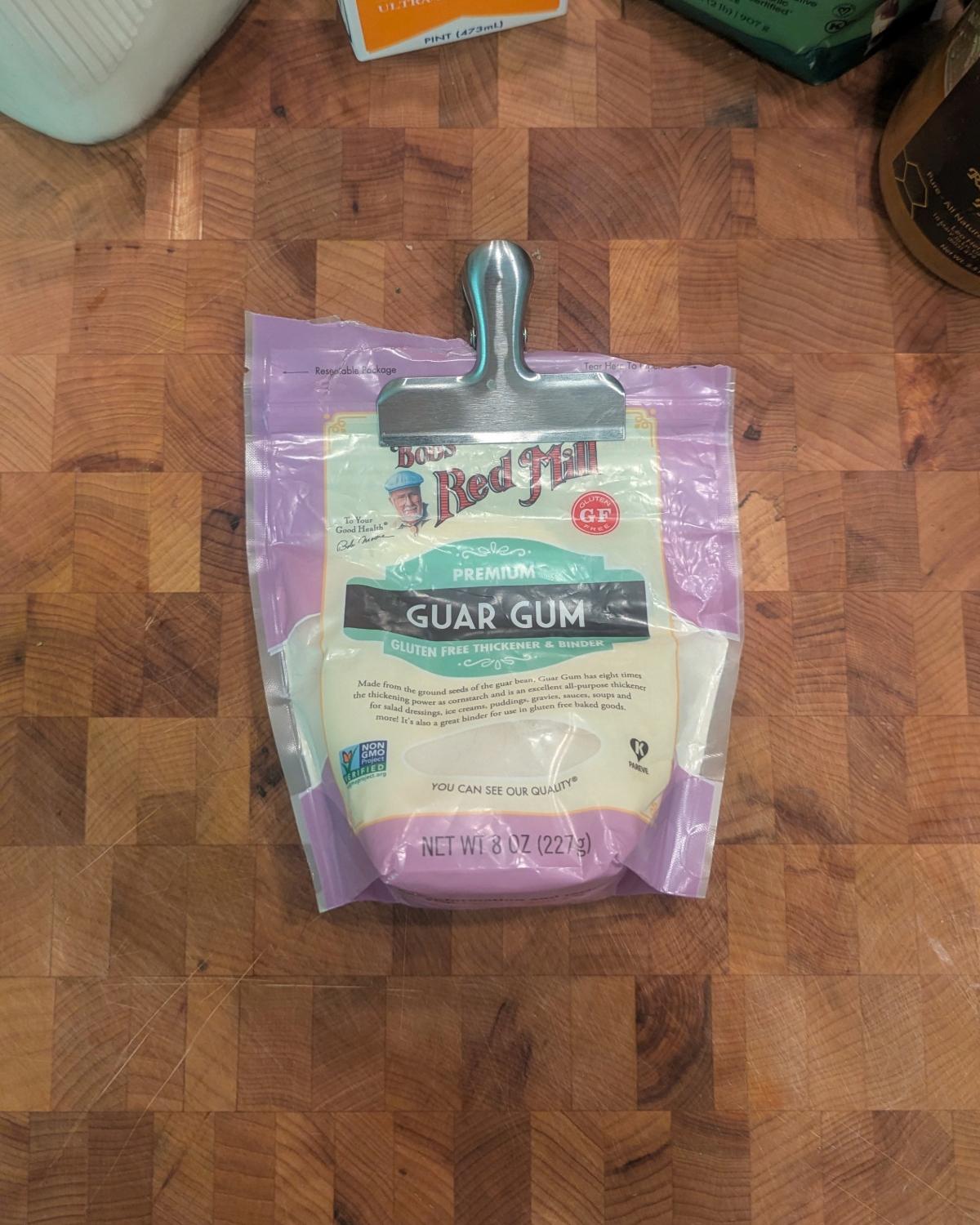
A short disclaimer before we get into it: I work hands-on with guar gum and egg yolks. But I’ve heavily researched every other stabilizer mentioned so I can give you the real pros and cons, plus my POV.
Best Stabilizer for Smooth Ice Cream Texture
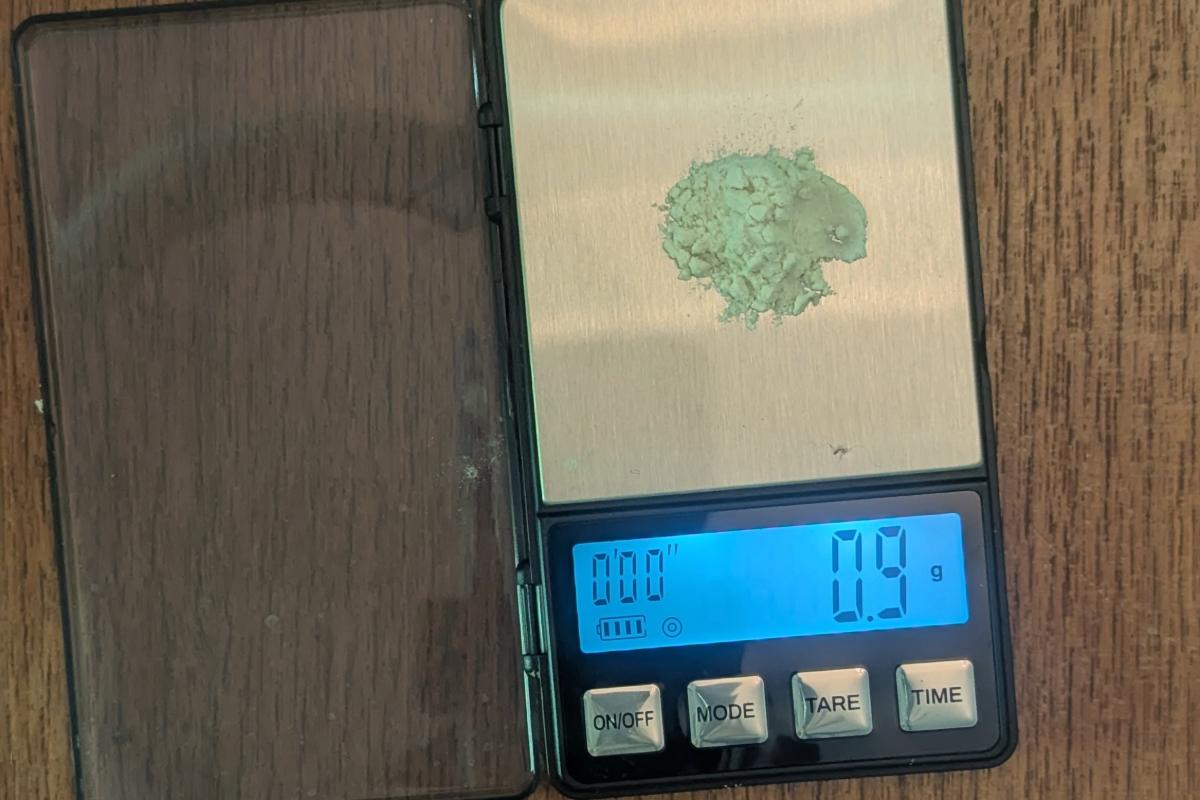
If you just want the answer: guar gum is the best all-around stabilizer for smooth, scoopable homemade ice cream—and my personal favorite. Use about 0.3 grams per quart of base, mixed into your dry ingredients (sugar and skim milk powder) before anything liquid touches it. It gives you a noticeably smoother, less icy texture without changing the flavor, and it’s the easiest single stabilizer to get right on your first try.
Want to know why, and what your other options are? Keep reading below.
What Are Stabilizers?
Stabilizers are ingredients that bind free water, stop liquids and fats from separating, and prevent ice crystal growth during freezing. They also thicken up the texture, creating a creamier mouthfeel in the final product. You add just a little bit (we’re talking fractions of a gram here), and your ice cream turns out softer, chewier, and lasts longer in the freezer. I touched on stabilizers briefly in my pantry guide, but below I’m giving a full breakdown.
Emulsifiers vs. Stabilizers
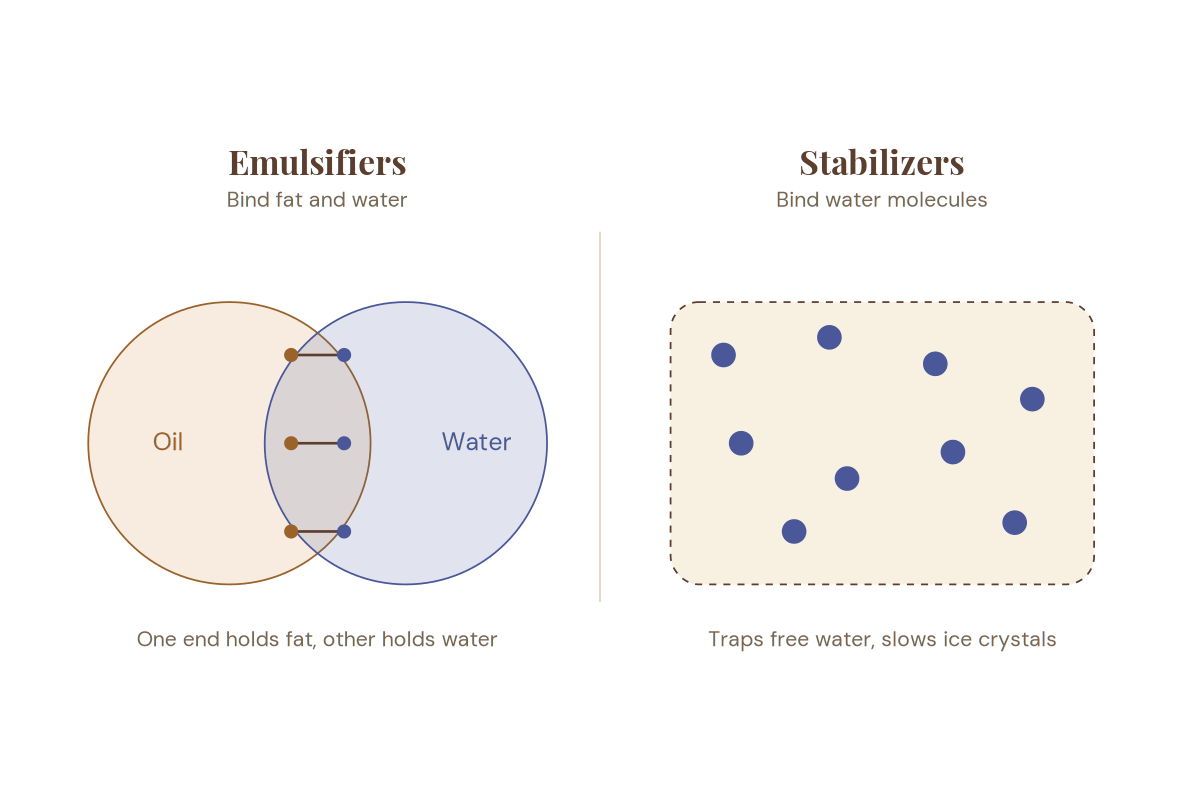
People (myself included for a time) often confuse stabilizers and emulsifiers, and it’s easy to see why. They both aim to achieve texture improvements. But they each do this in different ways.
Emulsifiers
As most of us learned in science class, oil and water naturally repel each other. An emulsifier steps in to bring them together. Emulsifier molecules have one oil-loving end and one water-loving end, so they can easily hold the two together. Egg yolks are the most common example of this in ice cream, and they help create a uniform, creamy base. Without them, your ice cream might turn out thin, icy, or have a greasy mouthfeel.
Stabilizers
Stabilizers, on the other hand, trap and absorb free-floating water molecules to prevent them from joining together and forming large ice crystals. By thickening up the mix and binding the water, these guys keep ice cream smoother over time and slow down the melting process.
Do I Need Both a Stabilizer and an Emulsifier?
While you don’t really need both a stabilizer and an emulsifier to create a stable base, they each add a different type of insurance that helps create a more consistent final product. As you’ve probably gathered by now, I’m a huge proponent of custard ice cream in general because I believe it has a superior texture. If you like thick, chewy ice cream, egg yolks are a must.
That said, egg-free doesn’t mean you’ll end up with a bad recipe. My Philadelphia-style ice cream skips the egg yolks (and cooking) entirely. But this means the stabilizer does a lot more of the heavy lifting eggs would otherwise cover. So, if you’re working from a Philly-style base, don’t skip the stabilizer.
Guar Gum: The Stabilizer I Actually Use
It might seem odd that I quit my search after trying just one ingredient, but I fell in love with guar gum at first churn. Derived from the guar bean, this hydrocolloid powder can absorb up to 10–20 times its weight in water. Because of that, you only need a tiny amount to get a smooth texture; I use just 0.3 grams per quart of base.
This powder dissolves in cold liquid, and it works best if you mix it with your other dry ingredients before introducing any liquids. Like I said, it absorbs a lot, and it does so very quickly. This means it tends to clump up as well. If you distribute it evenly first, you won’t have to wrestle with rubbery chunks later on.
Over- or under-dosing guar gum can lead to all kinds of issues. Too little, and your ice cream won’t noticeably improve. But too much and your custard will turn into a thick brick. I made this mistake recently by not adjusting my stabilizer down when I added freeze-dried fruit powder to a raspberry ice cream recipe I was working on. It turns out, all the fiber in freeze-dried fruit also absorbs tons of free water. Combined with the guar gum, it was incredibly thick and borderline too creamy. So always pay attention to your add-ins on top of your stabilizer amount.
Other Ice Cream Stabilizers To Consider
While I’ve focused on my personal gold standard, there are several other stabilizers you might encounter in the world of ice cream science. If you’re looking to experiment or use what you already have on hand, here’s a breakdown of the alternatives:
| Guar Gum | Xanthan Gum | Locust Bean Gum (w/ Guar) | Commercial Blend | |
|---|---|---|---|---|
| Texture Effect | Stretchy, chewy, smooth | Less elastic, cleaner break | Professional, scoopable body | Consistent batch to batch |
| Ease of Use | Easy; clumps if added straight to liquid | Very easy; disperses well in liquid | Needs heat to activate; rarely used alone | Easiest; pre-measured and balanced |
| Best For | Most home ice cream makers — my go-to | Gluten-free kitchens, or if you already have it on hand | Anyone wanting a step up from guar alone | Frequent churners who don’t want to weigh individual gums |
← Swipe to see all stabilizers →
Xanthan Gum
If you’re gluten-free, you’ve likely heard of this one before. And now you might be wondering, “Can I just use the xanthan gum I already have in my pantry?” Here’s the skinny:
- The Science: Like guar gum, xanthan is incredibly potent and only requires a tiny pinch. However, it behaves differently. Guar gum creates a stretchy, almost marshmallow-like texture. Xanthan gum, on the other hand, produces ice cream that’s less elastic and more prone to clean breaks on the spoon.
- The Benefit: It disperses much more easily in liquids than guar gum, which can sometimes be finicky about clumping.
- My Take: I haven’t tested this in my own kitchen yet. If you decide to try it, expect a slightly different texture than what my recipes typically provide. If you give it a go, I’d love to hear how your scoop holds up—drop a comment and let me know your results!
Locust Bean Gum (Guar/LBG Blends)
As I mentioned in my pantry staples post, locust bean gum is made from the seeds of the carob tree. Here’s how it works:
- The Science: LBG works similarly to guar gum, but it requires heat to activate its hydrocolloid properties and is rarely ever used on its own.
- The Benefit: When you combine them in a 2:1 ratio (guar to LBG), you get the best of both worlds: the immediate thickening of guar with the crystal-fighting, body-building properties of LBG. This duo creates a professional, scoopable texture that is hard to beat.
- My Take: I haven’t tested this blend in my own kitchen yet, but if I were to consider a blend, this would be my next logical step. If guar alone isn’t cutting it for you and your setup, I recommend adding LBG before stepping up to a completely different stabilizer or a commercial blend.
Commercial Stabilizer Blends
For the ice cream enthusiast who is churning batches weekly rather than monthly, you might be tempted by “all-in-one” stabilizers like Cremodan 30 or Avacream. Here’s what you need to know:
- The Science: Rather than buying individual gums and emulsifiers, these blends provide a standardized, balanced ratio of stabilizers (typically a mix of guar gum, locust bean gum, and sometimes carrageenan) and emulsifiers (often mono- and diglycerides). They’re formulated to get all the benefits of each individual gum in a pre-mixed product.
- The Benefits: Because they’re pre-mixed by food scientists, you get a reliable texture every single time you churn. They simplify your mise-en-place and measuring with fewer risks of over- or under-dosing.
- My Take: These are super convenient and easy to use. If you want consistent performance across batches, consider trying out one of these blends. If you prefer to dial in your perfect texture based on your own preferences, a custom homemade blend may suit you better.
Should I Add Stabilizers to My Homemade Ice Cream Mix?
Now that you have a better understanding of the different types of stabilizers, you might be wondering if you really need to incorporate them into your own recipes. The honest answer is: it depends on a few things:
- Your Recipe: A proper ice cream base balances fat, sugar, milk solids non-fat (MSNF), and water. An unbalanced base will never freeze quite right, and it’ll definitely go icy. If you’re using a recipe that came straight from your hand-crank ice cream maker’s instruction booklet, you might want to rethink.
- Your Equipment: A hand crank or bowl freeze ice cream maker will never get quite as cold or churn quite as evenly as a compressor machine. That can be a major problem for texture, though not an unsolvable one.
- Your Storage Limitations: Home freezers cycle on and off periodically, so they’ll never keep your base as consistently cold as a commercial blast freezer. You can work around this a bit by storing your ice cream all the way in the back, but it still won’t last quite as long, and it’ll always be a bit more prone to freezer burn.